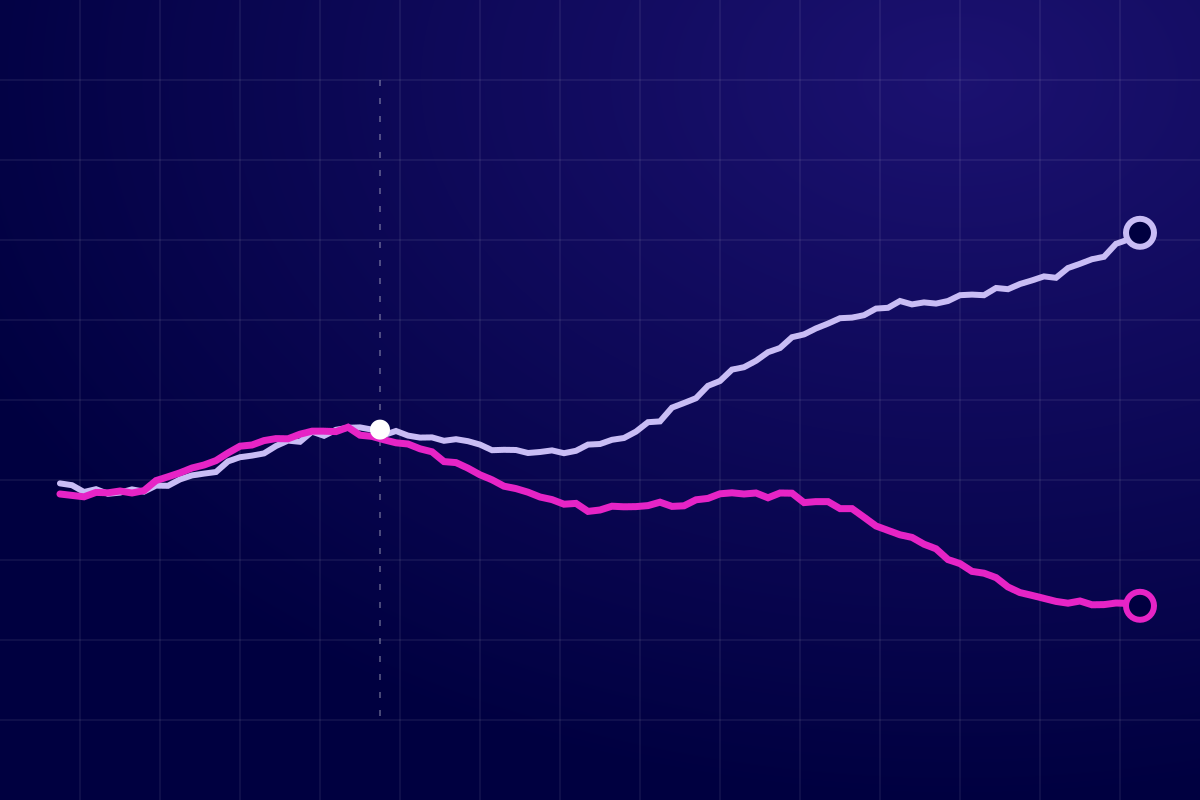
Cost per member per month, members with a hospital admission
Study note. IBM MarketScan claims, 3.5 million commercially insured members. The same data set as the Population Health Management paper by the same team. Analysis by Santa Barbara Actuaries, funded by Laguna Health. This report is not peer-reviewed.
The question
Care teams know that depression, anxiety, and substance use make recovery harder. This report asks how much harder, in dollars. In a commercial population, how do mental health and substance use (MH/SA) diagnoses change the cost of members who are admitted to the hospital?
How the study worked
Santa Barbara Actuaries analyzed claims for 3.5 million commercially insured members from the IBM MarketScan database. They split members by two factors: whether the member had an inpatient admission in the year, and whether the member had an MH/SA diagnosis. Then they compared the cost per member per month (PMPM) for each group, and followed the members who were discharged home for 12 months.
What it found
- Admitted members are a small, costly group. About 4% of members had an admission. Their cost was $4,149 PMPM, compared with $301 PMPM for members with no admission. Together they accounted for 37% of total spend, more than $6 billion a year.
- MH/SA diagnoses are more common after admission. 33% of admitted members had an MH/SA diagnosis, compared with 13% of members with no admission.
- MH/SA diagnoses raise cost in every group. Admitted members with an MH/SA diagnosis cost $5,170 PMPM, compared with $3,563 without one, about 45% more. For members with no admission, the cost was $644 vs. $243 PMPM, about 2.6 times as much.
- Readmissions follow the same pattern. Half of the patients readmitted within 30 days (2,504 of 5,481) had a mental or behavioral health diagnosis.
- Going home is often not the last stop. About 40% of patients discharged home moved to a more intensive setting within a year.
What it means for health plans
Mental health is not a separate program from medical cost. For members who leave the hospital, an MH/SA diagnosis is one of the clearest signs of higher cost and higher readmission risk. Care teams that screen for mood and substance use after discharge, and act on what they find, focus their time where it changes the most.