The Best Time to Close a Care Gap Is While the Member Is on the Line

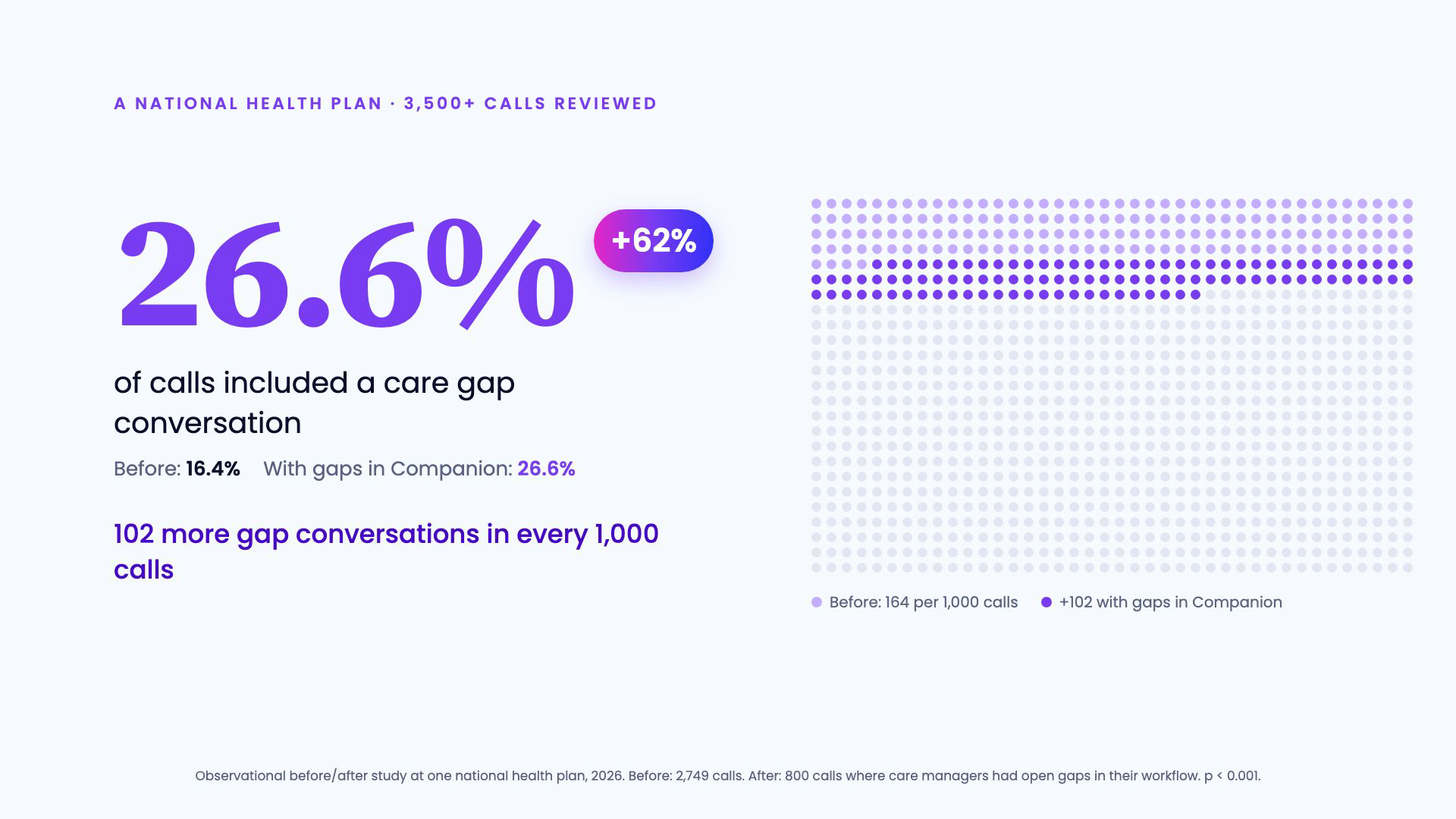
When open care gaps sit in the care manager's workflow, care gap conversations rise by more than 60%.
Every health plan member has a list. A colorectal cancer screening that is overdue. A diabetic eye exam that never got scheduled. An annual wellness visit, a blood pressure check, a statin that was never started. These are care gaps, and closing them is one of the clearest ways a plan improves both member health and its quality results.
The stakes are high. HEDIS measures like these feed Medicare Star Ratings, NCQA health plan ratings, and many value-based contracts. In Medicare Advantage alone, plans rated four stars or higher will receive more than $13 billion in quality bonus payments in 2026 [1]. And the gaps are real: about four in ten US adults aged 45 to 75 are not up to date on colorectal cancer screening, and most of them have never been screened at all [2].
The conversation that does not happen
Care managers already talk to these members. Their calls are long and personal, and they are often the only real conversation a member has with the plan all month. That makes every call a natural moment to close a gap.
But the gap list usually lives in a separate system. To use it, the care manager has to open another tool, search for the member, and read the list before the call. Many calls do not connect, so that prep time is often lost. On a busy day, the care manager starts the call without the list. The member hangs up without hearing about the screening they need, and the gap stays open for another month.
In a review of nearly 2,750 care management calls at one national health plan, care managers discussed at least one of the member's open gaps on only 16.4% of calls. The rest were missed chances. Not because care managers did not care, but because the information was not in front of them.
Bring the list to the call
Our customers asked us, again and again, to bring care gaps into the call. So we researched the best way to do it. Every time, we arrived at the same answer: the list has to live where care managers already work. It has to be ready before the call, stay in view during it, and never interrupt the conversation.
So that is what we built. Laguna Companion now shows each member's top open care gaps in Call Prep and on the live call, with no second system to open and no extra step.
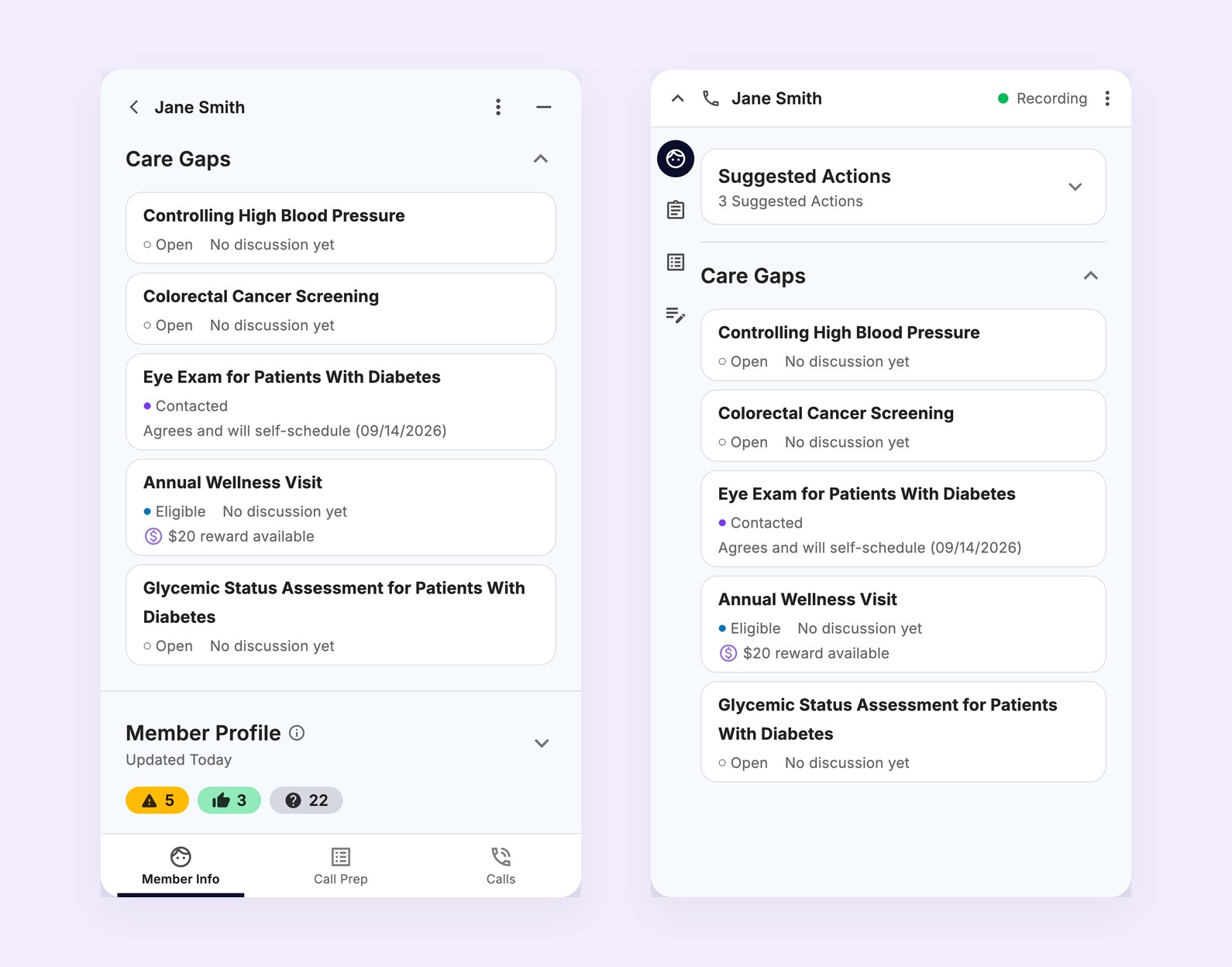
Before the call. When the care manager opens the member, the top open gaps appear in Call Prep, next to the rest of the member's story. A quick look is enough to plan the conversation.
On the call. The same gaps stay in view during the live call. When the moment is right, the care manager raises the gap that matters most to this member now.
With context. Each gap can show its status, the last outcome, and any reward waiting for the member, when the plan sends this data. 'Declined last month' and 'No discussion yet' call for very different openings, and the care manager knows which one they are walking into.
We also made a few deliberate choices. Companion is read-only: it never edits a care gap, and the plan's care gap system stays the source of truth. It pulls a fresh list each time the care manager opens the member. It shows the top five gaps, so the care manager can focus. And it does not interrupt the call with alerts. The care manager decides which gap to raise, and when. This follows the same principle behind the rest of Companion: show information when the clinician can use it, not in the middle of a sentence.
What changed
The same health plan turned the feature on in stages, first for a few users, then a team, then the whole organization. The study compared calls before the feature (2,749 calls) with calls after the organization-wide rollout where care managers used the member record around the visit (800 calls). Every call got the same full-transcript review against each of the member's open gaps.

That is 102 more care gap conversations in every 1,000 calls, a lift of more than 60%. Care managers raised gaps on their own nearly twice as often. Of the gaps that were discussed, the care manager started the topic 54% of the time, up from 43%. The difference is statistically significant, and it held across the wider population, not only the first team to use the feature.

The member side moved too. When a member mentioned an eye doctor or a blood pressure reading, care managers were more likely to connect it to the open gap, because they could see it.
The lift showed up across measures. Each number is the share of open gaps of that type, not the share of calls.

The largest relative gains came from visit-type gaps like the annual wellness visit, which came up almost three times as often. These are the gaps that are easiest to forget, because nothing else on the call points to them. A list in view is enough to bring them back into the conversation.
What this shows, and what it does not
This study measures conversations, not closed gaps. That is deliberate. The conversation is the step a care manager controls, and it has to happen before a screening gets booked or a prescription gets filled. Closure shows up later, in claims, on the plan's own timeline.
It is also an observational study at one organization. The results are strong and consistent, and each plan can measure its own. Laguna can track the share of calls with a care gap conversation before and after the feature goes live.
More from the calls you already make
Most quality programs try to close gaps with new outreach: more campaigns, more letters, more calls. Companion takes a simpler path. Your care managers already talk to members every day. When the open gaps are in front of them, more of those conversations move a gap forward. No new outreach program, no change to your care gap system, and a result you can measure on real calls.
See how care gaps work in Companion · Talk to us
Study note: observational before/after study at one national health plan, 2026. Before: 2,749 calls. After: 800 calls where care managers had open gaps in their workflow. A gap counts as discussed only if the care manager named or engaged that specific HEDIS measure. p < 0.001.
References
- KFF. (2026). Medicare will spend more than $13 billion on the Medicare Advantage quality bonus program in 2026. https://www.kff.org/medicare/medicare-advantage-quality-bonus-payments
- Centers for Disease Control and Prevention. (2025). Baseline estimates of colorectal cancer screening among adults aged 45 to 75 years, BRFSS 2022. Preventing Chronic Disease, 22. https://www.cdc.gov/pcd/issues/2025/25_0175.htm
Get in Touch 👋
Let’s talk about how Laguna can Elevate Your Care 💜 Team