The relationship is the intervention

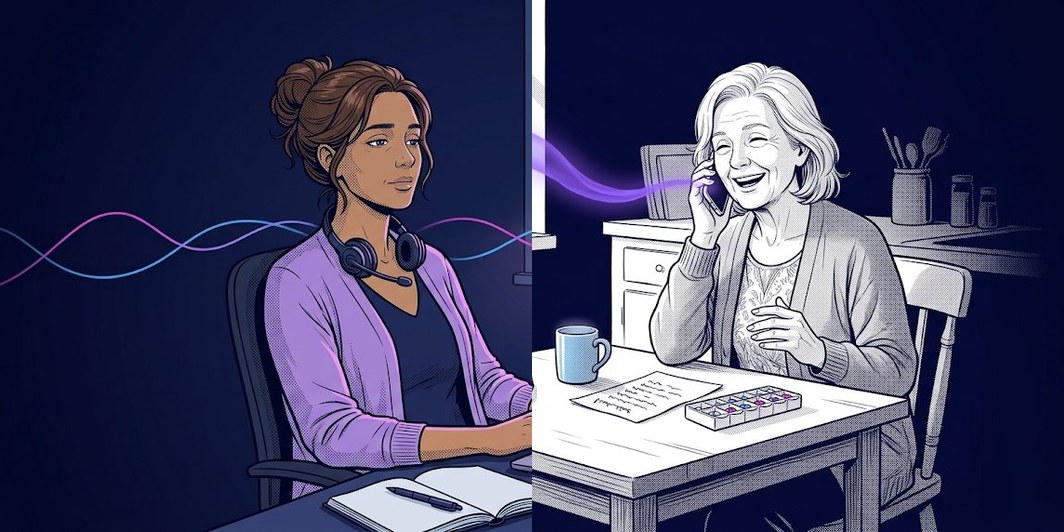
A care manager can ask every right question, confirm every medication, and book every follow-up, and the member still does not engage. Another call covers less ground, but the member opens up, names what worries her, and agrees to a plan she helped to choose. Most care managers know the difference from experience. Research has a name for it: the working alliance.
This article explains what the working alliance is, why it is one of the most reliable predictors of outcomes in care, what the member brings to it, and how clinicians can make it stronger. It also shows how Laguna measures the alliance on every care management call, and what we see across calls.
What the working alliance is
In 1979, Edward Bordin described the working alliance as three parts that work together [1]:
- Agreement on goals. The clinician and the patient agree on what they work toward.
- Agreement on tasks. They agree on the steps that get them there.
- The bond. The patient trusts the clinician and feels heard and respected.
Bordin wrote for psychotherapy, but he said that the concept applies to any relationship in which one person helps another to change. Horvath and Greenberg turned the three parts into the Working Alliance Inventory, which researchers still use today [2]. Later, Falkenström and colleagues made a six-item version for use after every session, the Session Alliance Inventory [3]. It has two parts: working together on goals and tasks, and the bond.
In plain words, the alliance answers one question: are the two of you working together, and does the member trust you enough to do it?
Why it matters
The alliance is one of the most studied factors in all of psychotherapy research. A meta-analysis of 295 studies with more than 30,000 patients found a consistent link between the alliance and outcomes (r = .28) [4]. The link held across treatment types, patient groups, countries, and the type of rater. It held when the patient, the therapist, or an outside observer rated the alliance.
The same pattern shows in medical care:
- Physical rehabilitation. A systematic review found that a stronger alliance went with better adherence, better physical function, and higher satisfaction [5].
- Physician care. In patients with chronic conditions such as lupus, diabetes, and kidney disease, a stronger physician-patient alliance went with better adherence, higher satisfaction, and better outcomes [6].
Care management lives on engagement. A member who trusts the care manager and shares the goal takes the call, tells the truth about symptoms, and follows through on the plan. That makes the alliance a strong signal of the quality of the work.
What the member brings, and what can change
Members do not come to the first call as a blank page. They come from home with their own way of relating to people who try to help. Some trust easily. Some had poor care before and stay careful. Some find it hard to ask for help, or to accept it.
Research supports this. A meta-analysis found that patients with more secure attachment styles form stronger alliances, and patients with less secure styles form weaker ones [7]. Part of the alliance is something the patient brings.
That is not the whole story. Zilcha-Mano and colleagues separate the alliance into two parts [8]:
- The trait-like part. This is the stable level that each patient tends to have, from their history and their style.
- The state-like part. This is how the alliance changes from session to session, above or below that stable level.
Both parts predict outcomes. The state-like part is the one the clinician can change, and it is the part that drives change [8]. In a study of 241 patient-therapist pairs, the strongest predictor of the outcome of a session was a change in the patient’s own rating of the alliance during treatment [9].
A guarded start is not a failure. Some members need several calls before they trust anyone. The direction over time matters most.
Clinicians can make the alliance stronger
If the alliance only reflected the patient, a score would be of little use to the clinician. The evidence shows that clinicians can change it, and that feedback helps.
- Feedback on progress. A meta-analysis of 24 studies found that routine feedback to clinicians improved outcomes, and almost doubled the rate of good outcomes in patients at risk of a poor result [10].
- Feedback raises the alliance. In a randomized trial, clients whose therapists used session-by-session feedback on progress and the alliance improved more [11]. In those clients, the alliance grew more during the first two months, and this growth explained about a quarter of the benefit [12].
- Repair after strain. When the relationship comes under strain and the clinician repairs it, outcomes are better (r = .29) [13].
The common thread is simple. A clinician who can see the alliance can respond to it. A clinician who cannot see it has to guess.
How Laguna measures the alliance
Laguna Companion gives care managers feedback after their calls. One part of that feedback is an alliance score and a short written observation. We designed both in the spirit of the working alliance research, for the reality of care management calls.
The Conversational Alliance score in Companion. Each level has its own name and color.
What we score. The score describes the relationship that the call shows: how well the care manager and the member work together on goals and steps, and how much trust and openness the member shows. The topic of the call does not change the score. A hard diagnosis does not raise it. A short call, a routine check-in, or a member who says no to an optional program does not lower it.
What we do not score. We do not score a checklist of what the care manager did. Greeting the member, checking identity, and reviewing medications are part of good practice, but they are not the alliance.
How we write the observation. The observation is written to the care manager. It gives a judgment about the alliance, says what it rests on, and names the one thing the member said or did that shows it. It describes what the call shows. It does not explain why the score is not higher, and it does not blame.
How we teach. On an early, short, or difficult call, the observation adds one practical skill for the next call. For example: ask the member what they hope to get from the program, let the member choose the next topic, or reflect a worry before moving on. When a member is guarded, the observation says that this is common and that trust often takes a few calls.
These are examples of the kind of observation a care manager sees. They are composites, not text from real calls.
What Laguna observed
Early days, and she is polite but brief. She answered each question and agreed to a call next week, which shows she is willing to keep the door open. Some members are guarded at first; asking what she hopes to get from the program can give the two of you a shared goal.
What Laguna observed
A steady check-in gives this partnership a respectful base. He confirmed his new medication routine and agreed to the Friday call, which shows he is willing to keep working with you. Asking which part of his recovery he wants help with can give him a bigger say in the next call.
What Laguna observed
A goal of her own now shapes the work. She raised her worry about the stairs at home and chose the first step with you, which makes the plan hers, not only yours.
What Laguna observed
Trust carries this work with the family. The son described how hard the last month has been and asked you to help plan the next visit, which shows he sees you as part of his father’s care team.
What we see across calls
We looked at a sample of 160 recent care management calls from three programs. Our production model scored each call. Because the sample had the same number of calls in each length group, we weighted the results to the real mix of call lengths.
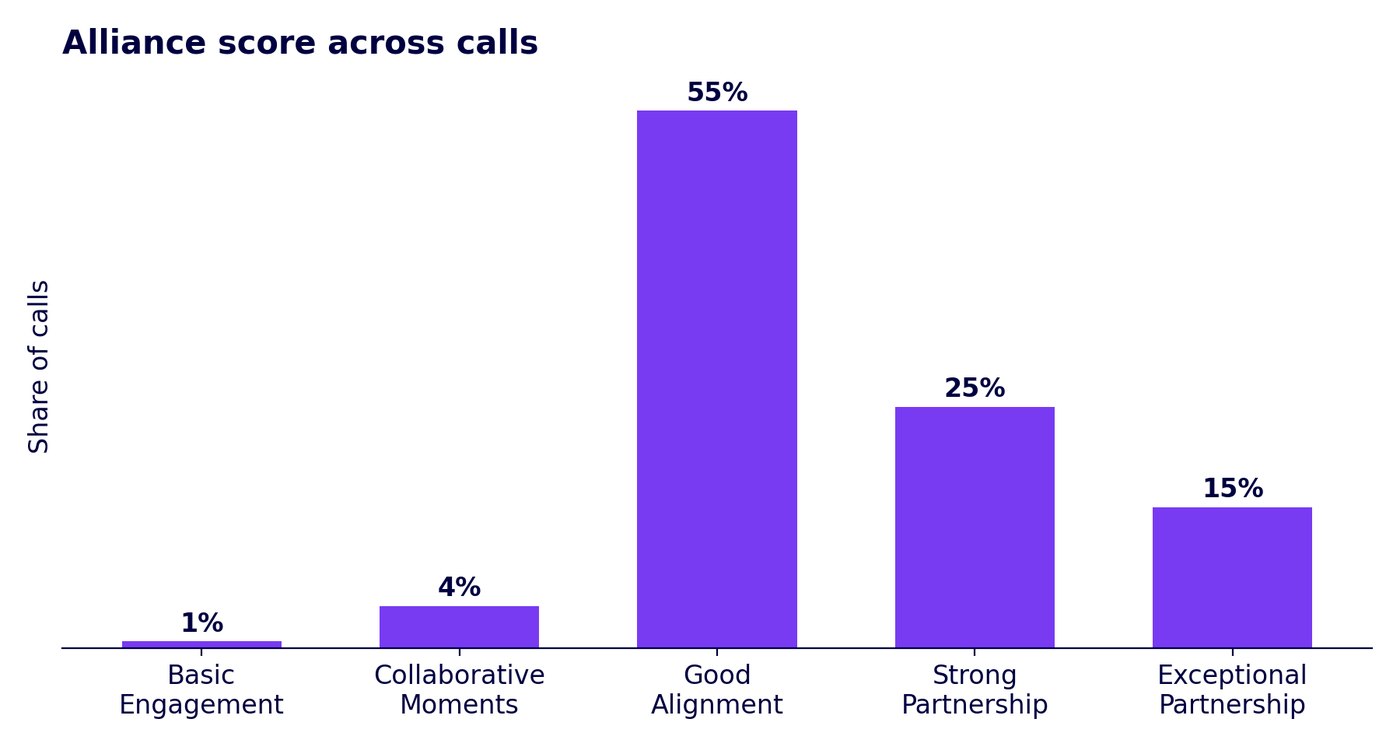
Most calls show a working alliance. About four in ten show a Strong or Exceptional Partnership.
Most calls show a working alliance. More than half of the calls show Good Alignment: the member and the care manager agree on the purpose of the call and on a next step. About four in ten calls show a Strong or Exceptional Partnership, where the member brings a concern of their own, helps to shape the plan, or shows clear trust. Few calls fall lower.
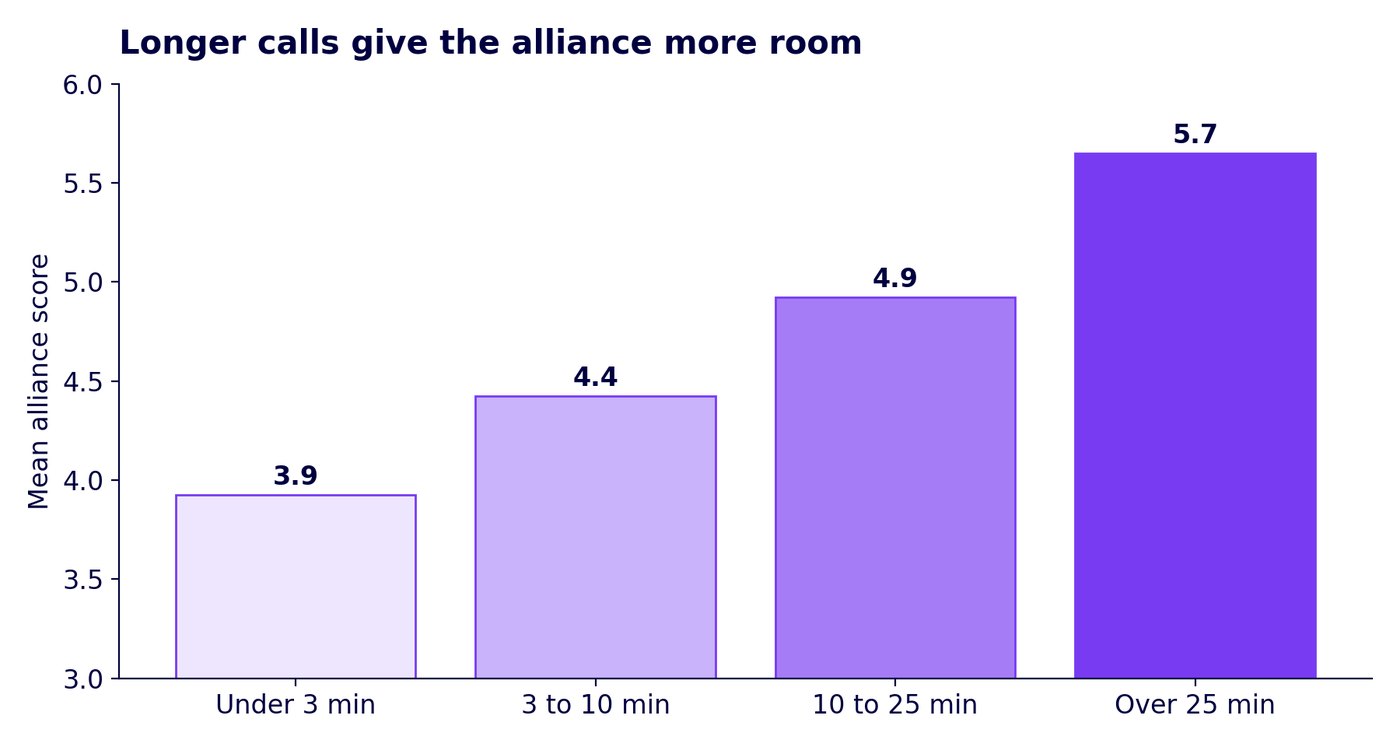
Longer calls give the alliance more room. Calls under three minutes are 29 percent of calls.
Short calls leave little room. More than a quarter of the calls last less than three minutes. These are often confirmations, reminders, or a quick check after discharge. They show less of the relationship, so their scores are lower, and the observation says so plainly. Longer calls give the member more time to raise a concern of their own and to work on it with the care manager.
A short call is not a weak alliance. It is a call with less evidence.
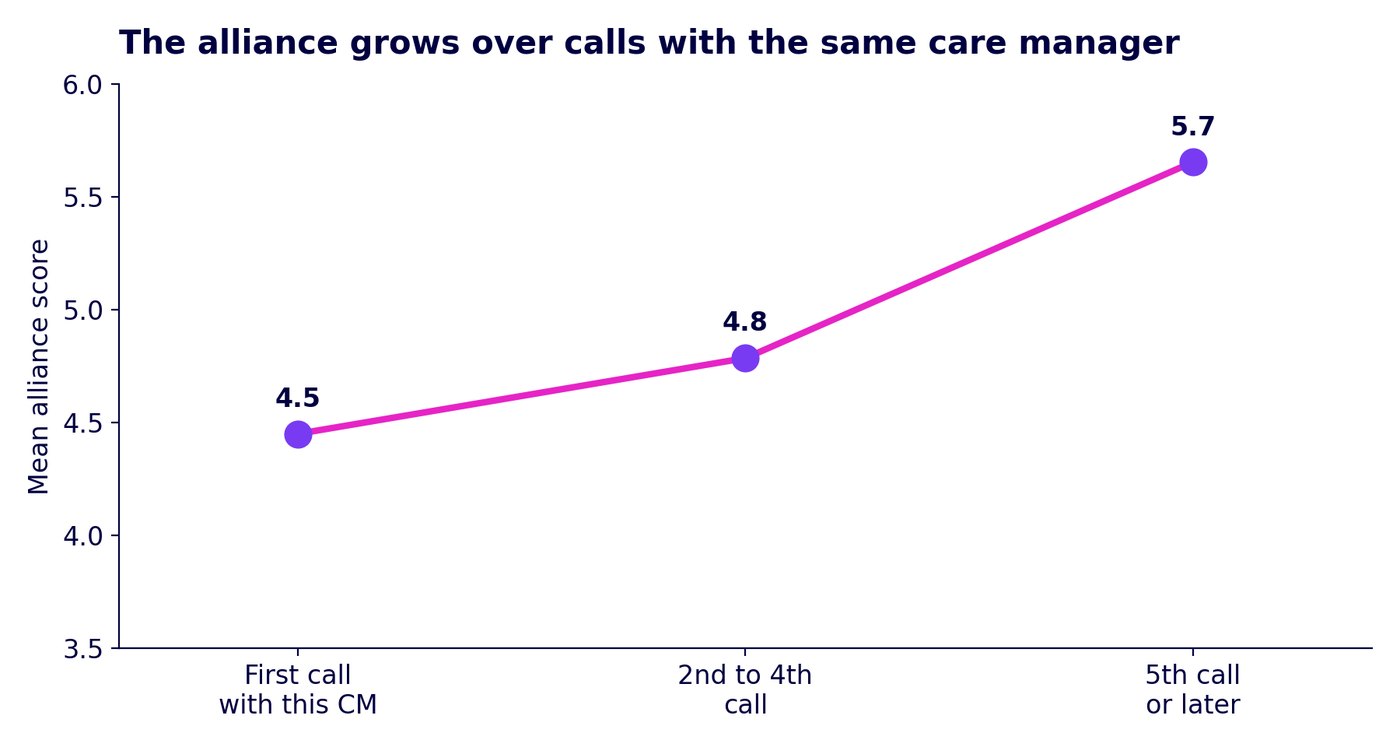
The score rises over calls with the same care manager. The rise remains after we account for call length.
The alliance grows with continuity. On a first call with a care manager, the mean score was 4.5. From the fifth call with the same care manager, it was 5.7. Later calls tend to be longer, but the rise remains after we account for call length. The model sees only the current call, not the history. The growth comes from what the member says and does on the call: they refer to earlier talks, raise their own concerns, and share more.
This matches what the research says about the state-like alliance. Members start where their history puts them. What happens over the calls makes the difference.
The point of measuring
A score is useful only when it helps the next call. We measure the alliance so that care managers can see the relationship, not only the tasks, and build it on purpose. A first call that is polite but guarded is a good start. A member who chooses her own first step is a sign that the work belongs to her. And a care manager who knows the difference has a better chance to help.
References
- Bordin, E. S. (1979). The generalizability of the psychoanalytic concept of the working alliance. Psychotherapy: Theory, Research & Practice, 16(3), 252–260.
- Horvath, A. O., & Greenberg, L. S. (1989). Development and validation of the Working Alliance Inventory. Journal of Counseling Psychology, 36(2), 223–233.
- Falkenström, F., Hatcher, R. L., Skjulsvik, T., Larsson, M. H., & Holmqvist, R. (2015). Development and validation of a 6-item working alliance questionnaire for repeated administrations during psychotherapy. Psychological Assessment, 27(1), 169–183. https://doi.org/10.1037/pas0000038
- Flückiger, C., Del Re, A. C., Wampold, B. E., & Horvath, A. O. (2018). The alliance in adult psychotherapy: A meta-analytic synthesis. Psychotherapy, 55(4), 316–340. https://doi.org/10.1037/pst0000172
- Hall, A. M., Ferreira, P. H., Maher, C. G., Latimer, J., & Ferreira, M. L. (2010). The influence of the therapist-patient relationship on treatment outcome in physical rehabilitation: A systematic review. Physical Therapy, 90(8), 1099–1110. https://doi.org/10.2522/ptj.20090245
- Fuertes, J. N., Toporovsky, A., Reyes, M., & Osborne, J. B. (2017). The physician-patient working alliance: Theory, research, and future possibilities. Patient Education and Counseling, 100(4), 610–615. https://doi.org/10.1016/j.pec.2016.10.018
- Diener, M. J., & Monroe, J. M. (2011). The relationship between adult attachment style and therapeutic alliance in individual psychotherapy: A meta-analytic review. Psychotherapy, 48(3), 237–248. https://doi.org/10.1037/a0022425
- Zilcha-Mano, S., & Fisher, H. (2022). Distinct roles of state-like and trait-like patient–therapist alliance in psychotherapy. Nature Reviews Psychology, 1, 194–210. https://doi.org/10.1038/s44159-022-00029-z
- Zilcha-Mano, S., Muran, J. C., Hungr, C., Eubanks, C. F., Safran, J. D., & Winston, A. (2016). The relationship between alliance and outcome: Analysis of a two-person perspective on alliance and session outcome. Journal of Consulting and Clinical Psychology, 84(6), 484–496. https://doi.org/10.1037/ccp0000058
- Lambert, M. J., Whipple, J. L., & Kleinstäuber, M. (2018). Collecting and delivering progress feedback: A meta-analysis of routine outcome monitoring. Psychotherapy, 55(4), 520–537. https://doi.org/10.1037/pst0000167
- Brattland, H., Koksvik, J. M., Burkeland, O., Gråwe, R. W., Klöckner, C., Linaker, O. M., Ryum, T., Wampold, B., Lara-Cabrera, M. L., & Iversen, V. C. (2018). The effects of routine outcome monitoring (ROM) on therapy outcomes in the course of an implementation process: A randomized clinical trial. Journal of Counseling Psychology, 65(5), 641–652. https://doi.org/10.1037/cou0000286
- Brattland, H., Koksvik, J. M., Burkeland, O., Klöckner, C. A., Lara-Cabrera, M. L., Miller, S. D., Wampold, B., Ryum, T., & Iversen, V. C. (2019). Does the working alliance mediate the effect of routine outcome monitoring (ROM) and alliance feedback on psychotherapy outcomes? Journal of Counseling Psychology, 66(2), 234–246. https://doi.org/10.1037/cou0000320
- Eubanks, C. F., Muran, J. C., & Safran, J. D. (2018). Alliance rupture repair: A meta-analysis. Psychotherapy, 55(4), 508–519. https://doi.org/10.1037/pst0000185
Get in Touch 👋
Let’s talk about how Laguna can Elevate Your Care 💜 Team