Health Systems Plan to Cut Their AI Vendors From 9 to 5. Health Plans Should Read the Survey Differently.


Health plans will cut AI vendors too. The ones that stay will live inside the system where care management already runs, and will prove they work on the plan's own calls, every day.
The survey
On November 18, Black Book Market Research published AI Vendor Survival Odds 2027–2028. It surveyed 412 verified healthcare AI buyers between September and early November. The headline: the median health system plans to go from nine standalone AI vendors today to five by 2028. The largest AI buyers plan to go from 17 to eight.
Two more findings explain why. Buyers report that they have realized a median of 41% of the return they were promised at sale. And the strongest threat to a standalone tool is the EHR: 63% of Epic-based health systems plan to replace at least one standalone AI tool with a native EHR feature. A comparable native feature is the leading reason buyers give for dropping a vendor, at 57%.
The survey is careful about what it is. Black Book says its findings reflect buyer experience and expectations, not confirmed vendor failures. Even so, it is the clearest picture we have of how buyers feel about the AI they bought in the last two years.
Most readers will take one message from it: standalone AI is in trouble, and the platform wins. We'd like to offer a different read for health plans.
Who the survey did not ask about
The findings are reported for health systems. The platform that threatens standalone AI is the EHR. Health plans are not broken out.
The care management and utilization management teams at a health plan work differently. Their calls with members run 30 to 60 minutes. Their documentation is long and structured: assessments, care plans, barriers, interventions. Their quality teams answer to NCQA, to Star Ratings, and to their own audit forms. And the system where their work runs is not an EHR. It is the plan's medical management system, where care management and UM teams open the member, document the call, and route the work.
Health plan leaders are asking a different question from the one in the survey: which AI is safe for their care teams, and which AI pays off.
The survey still answers that question well, if you translate it.
Three lessons for health plans
1. AI ends up where the work runs. For a health system, that is the EHR. For a health plan's care teams, it is the medical management system. A tool that asks a care manager to open a second window, copy a note, or keep a separate login is the tool a plan will drop when the vendor list gets shorter. The survey's 57% says this plainly: buyers drop what the platform can already do.
2. A promise is not proof. A median of 41% of promised returns is a gap between the sales deck and the work. Doug Brown, Black Book's founder, said the winners will be defined by "independently demonstrable outcomes." For a care management leader, that means outcomes you can see on your own calls, measured against your own standards, after go-live.
3. Not all AI is equally exposed. Ambient documentation has the lowest survival score in the survey (56 out of 100), and 54% of buyers see a high risk that the EHR replaces it. A generic note is easy to copy. AI voice agents and contact center AI score among the most durable. What is hard to copy is AI that knows one organization's forms, protocols, and standard of a good call, and keeps learning them.
Five questions to ask every AI vendor on your list
If your plan is counting its AI vendors, these questions separate the ones that will still be there in 2028.
- Does it work inside the system your care managers already use? Or does it add a window, a login, and a copy-paste step?
- Can it show its accuracy on your calls, this week? Not on a demo set. Ask how often it checks itself and what it found.
- Does it measure against your standards? Your assessment forms, your audit rubric, your documentation rules, not a generic template.
- What happens when the model underneath changes? Every AI vendor will change models. Ask how they retest before your care managers see the result.
- Can you leave? The survey found that 71% of AI contracts lack change-of-control termination rights and 58% lack data-portability terms. Read yours.
What we see
This is how we built Laguna, and these are the numbers we can show.
Laguna works inside the care management systems plans already run, with no integration required to go live. A typical go-live takes six weeks. Over time, Elligint Health plans to connect Laguna with Helios, starting with Laguna Companion, while each product stays available on its own.
The proof runs every day, not once:
- Documentation time. In a formal time study across six care management teams at a large multi-state health plan, post-call documentation time fell by 66% on average.
- A daily clinical check. Laguna checks its own documents every day. From October 1 to 22, 2026, it checked 10,655 documents and found fewer than 0.1% with a hallucination or a critical error.
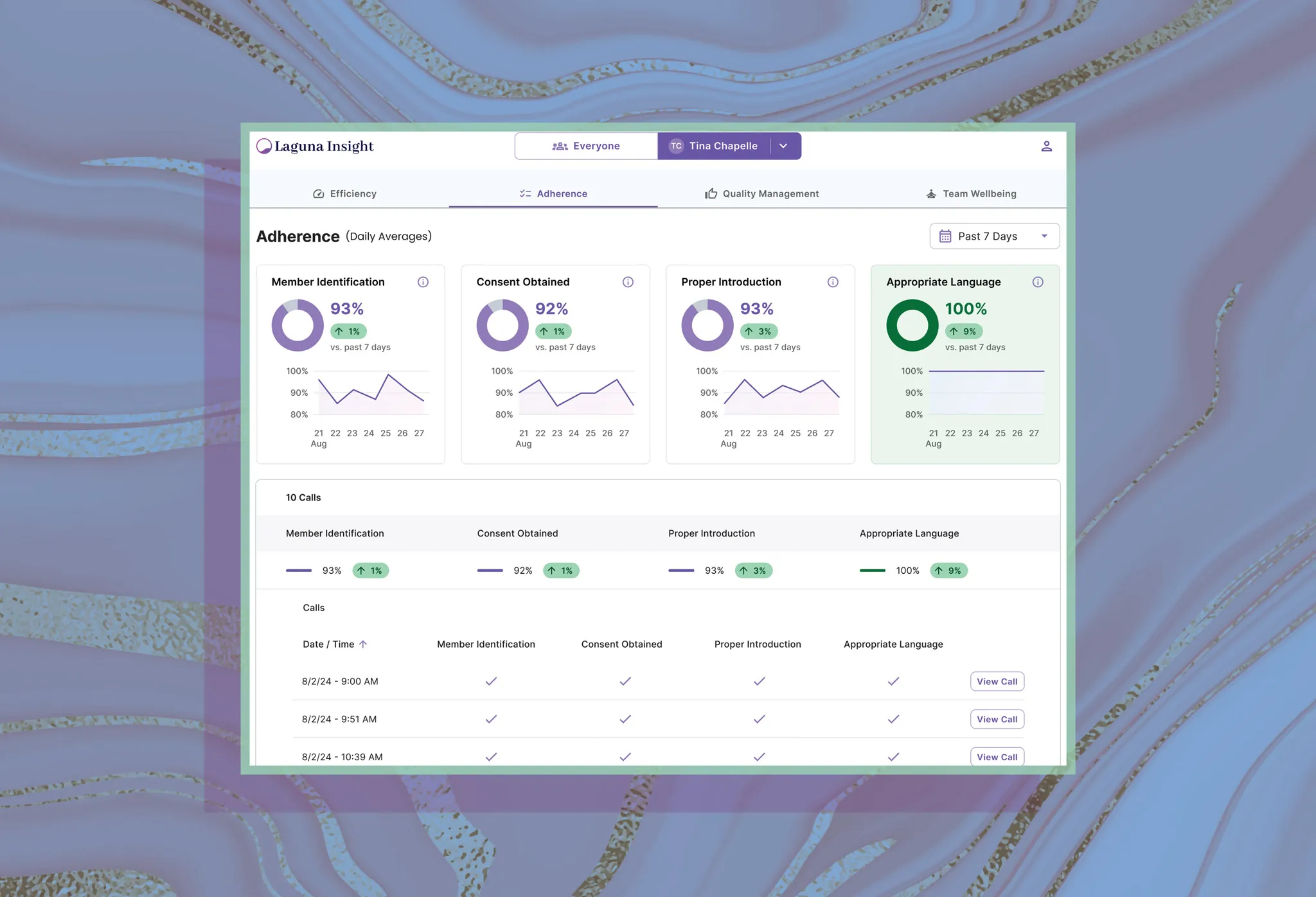
- Every call, not a sample. Laguna Insight reviews 100% of calls against the plan's own rubric. A typical manual program reviews one or two calls per care manager per month.
- Learning the plan's standard. Care managers' edits teach the AI the team's standard, with clinical leaders deciding what changes. In the best-performing programs, up to 92% of notes need no edits.
What this shows, and what it does not
Black Book surveyed buyers about health systems. We do not know yet how health plans will consolidate their AI vendors, and no survey we know of has asked them. Our reading is an argument, not a finding.
Our numbers come from our customers and our own monitoring. The 66% comes from one plan's formal time study. The 92% is the best-performing programs, and individual results vary. Each plan can and should measure its own, and we can track every one of these numbers for a plan from the first week.
The real question
The question is not how many AI vendors a plan has. It is how many of them work inside the place the work happens, and can prove it on this week's calls.
Fewer tools is not the goal. They need AI that their care managers use on every call, that their quality leaders can check, and that their boards can trust. That is the AI that survives the next renewal.
References
- Black Book Market Research. (2026, November 18). Healthcare AI Shakeout: Health Systems Plan to Cut AI Vendors Nearly in Half by 2028, Black Book Finds. Newswire
- Black Book Market Research. (2026). AI Vendor Survival Odds 2027–2028. 412 verified healthcare AI buyers, fieldwork September 12 to November 4, 2026. Report PDF
- Elligint Health. (2026, November 12). Press release.
- Laguna Health. Efficiency and quality case study.
Study notes: 66%: formal time study by a large multi-state health plan across six care management teams after its Laguna pilot. Daily check: Laguna's automated clinical review of generated documents, all environments, October 1 to 22, 2026. Up to 92%: best-performing program (250 summaries); individual results vary.
Get in Touch 👋
Let’s talk about how Laguna can Elevate Your Care 💜 Team